
School Setup
Curriculum Presets
Choose at sign-up whether your school is set up with the Nigerian curriculum, the British one, the Ghanaian one, an Islamic curriculum, both together, or nothing at all, and see the classes, subjects and terms you will get before you commit.
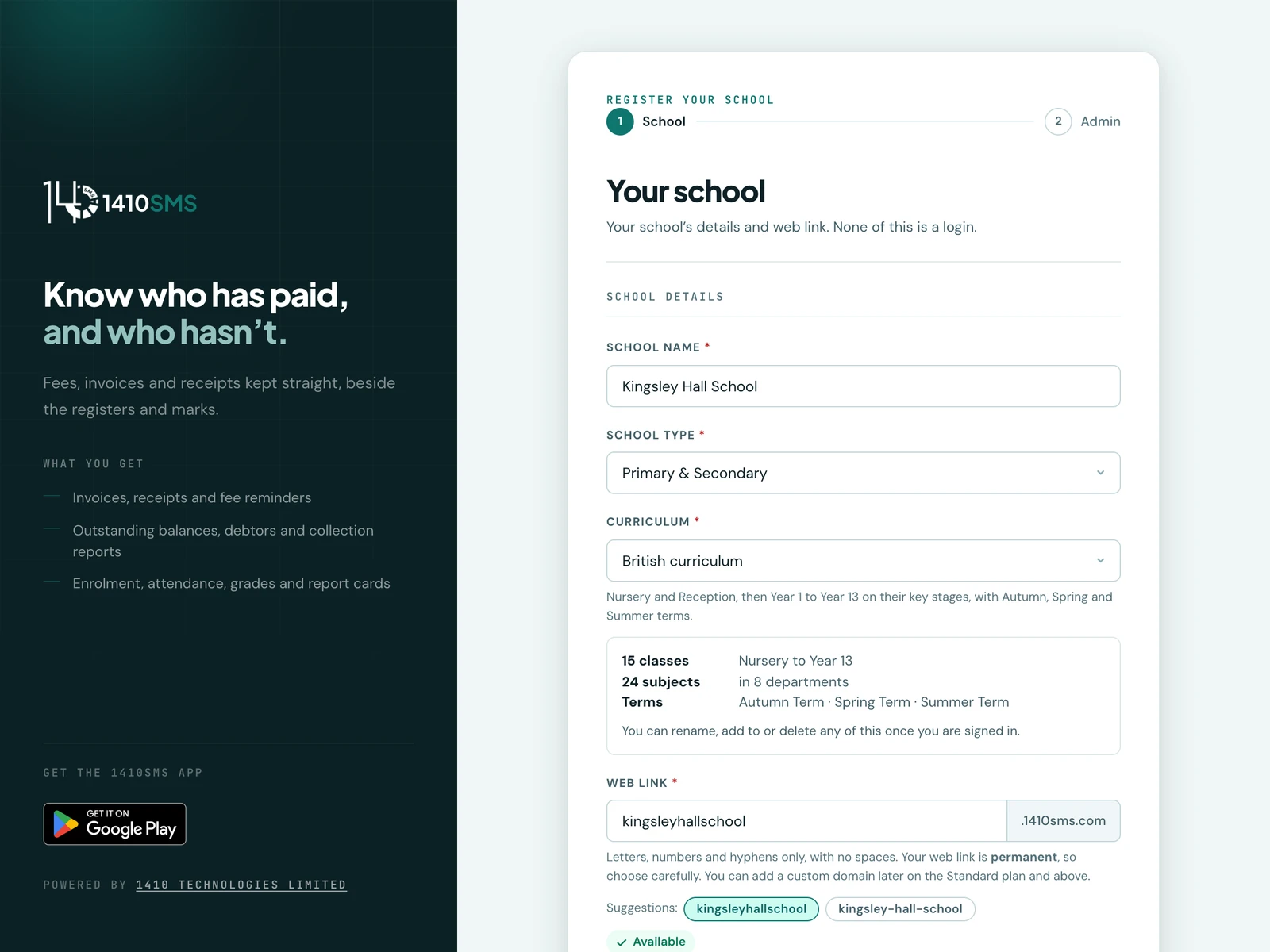
When you register, 1410SMS creates your classes, subjects, departments and terms for you, so the first person to sign in finds a school rather than an empty database. Curriculum is where you say what those should be.
It is a separate question from School type, and the two are asked side by side because they answer different things:
- School type is which stages you run: nursery, primary, secondary, or a combination.
- Curriculum is what you teach and what you call it.
A madrasah running the Nigerian ladder needs to answer both, and no single dropdown could have asked it.
What you can choose
Nigerian curriculum
The national ladder and its subjects, which is what every 1410SMS school got before this choice existed. You get Playgroup through Nursery 2, Primary 1 to Primary 6, and JSS 1 to SSS 3, as far as your school type runs, with the usual subject list filed under eight departments.
This is selected for you by default. If it is what you want, there is nothing to do.
British curriculum
For the many Nigerian schools that teach the British curriculum rather than the national one. It is not the Nigerian ladder renamed: the key stages fall in different places, and Year 7 is a secondary year here where it would be a primary one there.
- Fifteen classes at a school running the whole ladder: Nursery and Reception, then Year 1 through Year 13, as far as your school type runs. Nursery and Reception are set up as early years classes, so they are assessed on the developmental card rather than by subject score.
- Twenty three subjects filed under the same eight departments every 1410SMS school gets, including Religious Education, which is the one subject nothing else on the platform files under Religious.
- Autumn Term, Spring Term and Summer Term, so the tab you click matches the letter you send.
- The platform's own A to F grade scale. This is deliberate rather than an omission, and it is explained below.
Your classes are given what a pupil at that key stage sits. Key Stages 1 and 2 take English, Mathematics, Science, History, Geography, Computing, Art and Design, Design and Technology, PE and RE, with French added at Key Stage 2. Key Stage 3 adds Drama, Citizenship and PSHE. At Key Stage 4 the subjects change name the way the syllabus does: Science becomes Biology, Chemistry and Physics, and English becomes English Language and English Literature.
Year 10 and Year 11 carry that core and nothing else. French, RE, Computing, Art and Design, Design and Technology, Citizenship and PSHE all come off the class list there, because Key Stage 4 is chosen subject by subject and each of them is a choice rather than something every candidate sits. They stay on your Subjects page, so putting one back is a click.
Year 12 and Year 13 are given almost nothing on purpose. The sixth form is three or four subjects chosen per pupil, with nothing the whole year group sits, so a class list there would be subjects that nobody in the class actually takes. Add what you offer, which is a click on the class page.
The same applies to the IGCSE options: Business Studies, Economics, Computer Science, Drama, Art and Further Mathematics are all created for you and left off the class lists, because a class carrying every option is a report card with twenty columns you would delete before you could use it.
If you stop at IGCSE, delete Year 12 and Year 13. We create them because a school running A levels would otherwise have to add them by hand, and a class your oldest pupils sit outside the platform in is the more expensive mistake of the two.
Ghanaian curriculum
For a school in Ghana running the Standards-Based Curriculum. It is the first preset here that describes a school outside Nigeria, which is why it is also the only one that changes your holiday calendar.
- Fourteen classes at a school running the whole ladder: KG 1 and KG 2, Basic 1 to Basic 6, then JHS 1 to 3 and SHS 1 to 3, as far as your school type runs. KG 1 and KG 2 are set up as early years classes, so they are assessed on the developmental card rather than by subject score.
- Thirty four subjects filed under the same eight departments every 1410SMS school gets, from Ghanaian Language and Our World Our People through to the WASSCE electives.
- First, Second and Third Term, which is what Ghana already calls them and what the platform already names them. Nothing to translate.
- Ghana's own public holidays: New Year's Day, Constitution Day, Independence Day on 6 March, May Day, Founders' Day, Kwame Nkrumah Memorial Day, Christmas Day and Boxing Day, plus both Eids. Good Friday, Easter Monday and Farmers' Day move every year, so they are left for you to record as they are announced rather than seeded on a date that would be wrong.
Your classes are given what a pupil at that phase sits. Basic 1 to 3 take English Language, Ghanaian Language, Mathematics, Science, History, Our World Our People, RME, Creative Arts, Computing and PE, with French added at Basic 4. JHS carries Integrated Science and Social Studies in place of Science and Our World Our People, and adds Career Technology and Creative Arts and Design.
SHS is given the four core subjects and nothing else: English Language, Core Mathematics, Integrated Science and Social Studies. Above them the WASSCE is programmes rather than options, so no elective is taken by a whole year group and a class list carrying them would be subjects most of the class does not sit. Elective Mathematics, the three sciences, Government, Geography, Economics, Business Management, the two accounting subjects, Literature-in-English, the religious studies subjects, Visual Arts, Technical Drawing, Home Economics and Agricultural Science are all created for you and left off the class lists. Adding one is a click on the class page.
Subjects are renamed as a pupil climbs rather than carried up under both names: Science becomes Integrated Science at JHS, Mathematics becomes Core Mathematics at SHS, Computing becomes ICT and Creative Arts becomes Creative Arts and Design. Otherwise an SHS class would show two columns for one subject, one of them unmarked all year.
The classes are named Basic 1 to Basic 6 and JHS 1 to JHS 3 because that is what schools and
parents say. The curriculum's own numbering calls JHS 1 to 3 Basic 7 to 9; if that is what your
reports use, rename the three classes.
Like every other school outside the madrasah presets, you keep the platform's A to F grade scale rather than the WASSCE's A1 to F9 or the BECE's 1 to 9. The reasoning is the same one set out below. Your invoice currency is set under School Settings, since that follows the country you are in rather than the curriculum you teach.
Madrasah
The Islamic curriculum on its own, for a school that teaches no national curriculum alongside it:
- 13 classes, التمهيدي (Preparatory) through الابتدائي 1 to 6 (Elementary), الإعدادي 1 to 3 (Intermediate) and الثانوي 1 to 3 (Secondary).
- 20 subjects in three departments: القرآن الكريم (Qur'an Studies), الدراسات الإسلامية (Islamic Studies) and اللغة العربية (Arabic Language). Qur'an, Tajweed, Memorisation, Tafsir, Hadith, Fiqh, Aqeedah, Tawheed, Seerah, Manners, Inheritance, Usul, and the Arabic language subjects from grammar and morphology through to rhetoric.
- Arabic term names: الفصل الأول (First Term), الفصل الثاني (Second Term), الفصل الثالث (Third Term).
- A five-band grade scale in Arabic: ممتاز, جيد جدا, جيد, مقبول, ضعيف.
- Both calendars, so every date is shown in Gregorian and Hijri together.
Each subject is taught from the stage a madrasah normally starts it: the preparatory year takes Qur'an, memorisation, manners and Arabic, and Tajweed, Hadith, Fiqh and Aqeedah begin at الابتدائي 1.
Madrasah (integrated)
For a school that runs the national curriculum and the Islamic one. You get your Nigerian ladder exactly as the school type describes it, with the three Islamic departments added beside the standard eight and every Islamic subject created.
You also get the Arabic term names and both calendars, exactly as the madrasah preset above does. What you do not get is its Arabic grade scale: there is one grade scale per school and it marks every subject on the report card, so it would mark your Mathematics ممتاز as well as your Tajweed. Your school is marked the way it always was, and you can switch to the Arabic bands under School Settings if that is what you want.
Seven of the Islamic subjects are put on your classes to start with: Qur'an, memorisation, Arabic and manners throughout, plus Tajweed, Hadith and Fiqh from Primary 1 up. The other thirteen are created but left off the class lists, because a class already carrying a full national curriculum cannot also sit twenty extra subjects. Add the ones you teach to the classes that take them, which is a click on the class page rather than a form.
Set up manually
No classes and no subjects at all. Your departments are still created, because the subject import needs them. Use this if none of the above resembles your school, then either add your classes and subjects yourself or bring them in from a spreadsheet. See Departments & Subjects and Classes.
Your setup checklist knows you chose this, and asks for them: Add your subjects and Add your classes appear on it, in that order, before it asks you to add students. That order is not cosmetic, since every pupil is enrolled into a class and cannot be added until there is one.
Names are in Arabic first, with the English in brackets
A seeded madrasah class is one name, written as الابتدائي 1 (Elementary 1), and a subject as
القرآن (Qur'an). This is deliberate: it means the register, the report card and the invoice are
readable by a parent who reads either, and by a state inspector who reads only one.
Digits are Western throughout (الابتدائي 1, not الابتدائي ١) so that sorting, searching and
spreadsheet imports work, and so anyone can type a class name on the keyboard they already have.
Nothing about it is fixed. If you want القرآن on its own, rename it. Class and subject names are free text, and terms carry a separate display name you can change under Academic Calendar, Terms & Sessions.
What happens after you choose
The choice applies once, when your school is created. Everything it makes is then yours: rename it, delete it, add to it. There is no ongoing setting to change and nothing that will overwrite your edits later.
Two things a preset can also set, both of which you can change afterwards:
- The grade scale, under School Settings. Only the madrasah preset sets one; every other school keeps the platform's, including the British one. That is a decision worth stating: a British school might expect 9 to 1, or A* to U, and gets A to F instead. A grade is frozen onto a mark when the mark is entered, so a school given a scale it did not ask for has a term of marking to re-grade rather than a setting to change, whereas one that wants 9 to 1 sets it here in a few minutes and marks on it from the start. Your exam board issues its own grades at IGCSE and A level whatever this platform says.
- The calendar, under Settings, where a school can also record its own moon sighting if its community begins the month a day either side of the published Umm al-Qura table.
Eid is in your calendar, whichever curriculum you chose
Every 1410SMS school, madrasah or not, now gets عيد الفطر (Eid al-Fitr) and عيد الأضحى (Eid al-Adha) in its holiday calendar alongside its country's fixed-date public holidays: the six Nigerian ones, or the eight Ghanaian ones if you chose the Ghanaian curriculum. They are recorded against the Hijri calendar, so they move correctly against ours every year rather than being fixed to one date and drifting.
If your school teaches through either, or takes a different number of days, edit or delete them like any other closure. See Dates & Calendar.
On the phone
A school can register from the mobile app as well as the web, with the same choice. On the app's first screen, tap Register your school. The second step, School details, asks for School type and then Curriculum, a row of choices from Nigerian curriculum to Set up manually.
Each choice shows what it will create before you commit: how many classes, from the first to the last, how many subjects in how many departments, and the names of the terms. As on the web, the choice applies once, when the school is created, and everything it makes can be renamed, added to or deleted afterwards.
Ready to try it with your school?
Three-month Basic trial. No card required to register.