
Finance
Who to Chase First
Your debtors ranked by how hard the debt looks to collect rather than how large it is, with the facts behind every position so you can see why, and disagree.
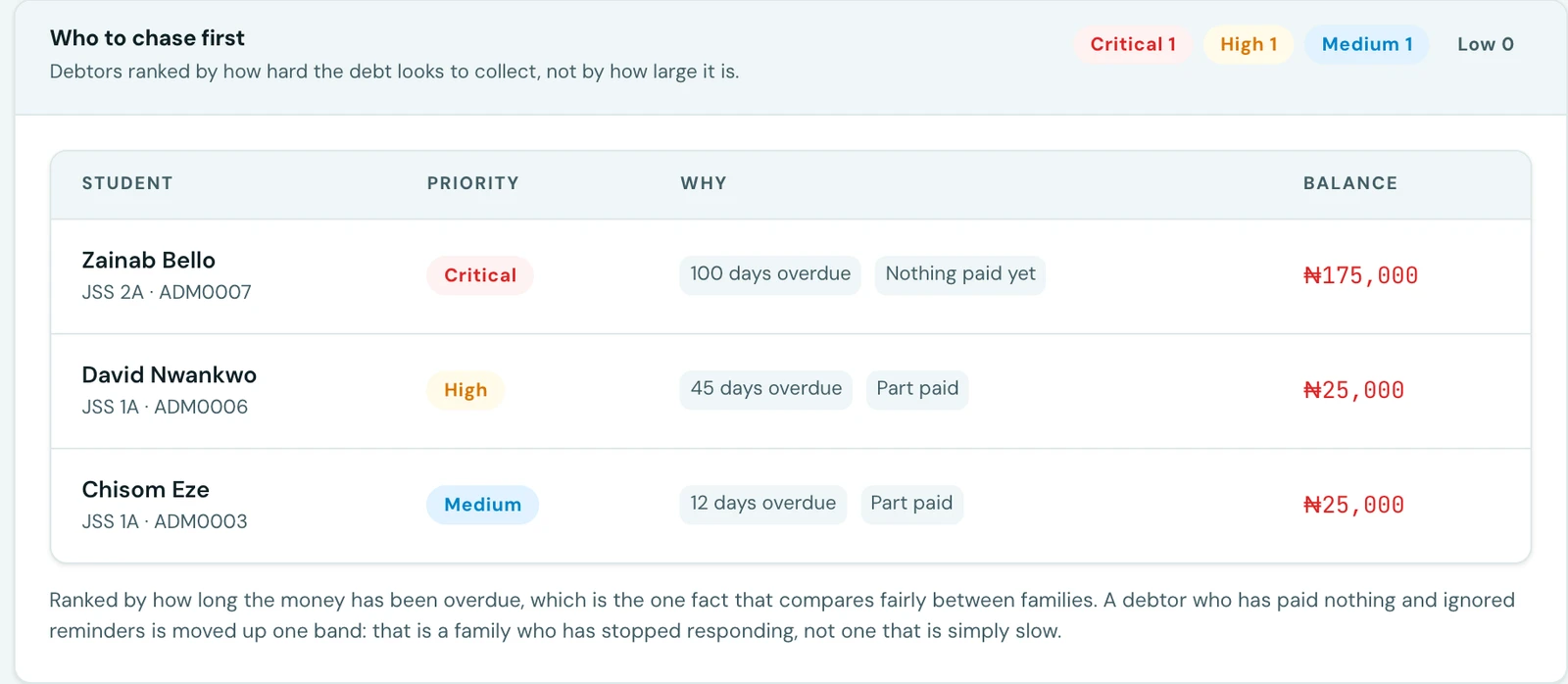
The Largest Debtors list answers "who owes the most". That is not the same question as "who should I ring this afternoon": the biggest debt is often owed by a family who always pays, eventually, while a smaller one has gone silent for three months.
Who to chase first, on the Outstanding tab, ranks the same debtors by how hard the money looks to get in.
How the ranking works
Each debtor is put into one of four bands:
| Band | What puts them there |
|---|---|
| Critical | 90 or more days overdue |
| High | 30 to 89 days overdue |
| Medium | 1 to 29 days overdue |
| Low | Owing, but nothing is late yet |
Days overdue decides the band, and everything else explains it. How long money has been late is the one fact that is unambiguous, compares fairly between families, and cannot be argued with, so it carries the ranking. Within a band, the largest balance comes first.
There is one exception, and it is deliberate. A debtor who has paid nothing at all and has ignored two or more reminders is moved up one band. That combination is not a slow payer; it is a family who has stopped responding, and the day count on its own would leave them behind larger but healthier debts. Both halves are needed, because either on its own is common and means very little.
Why every row shows its reasons
A priority on its own is not something you can act on, or tell a wrong answer from a right one by. So each row lists the facts that put it where it is: "45 days overdue · Nothing paid yet · 3 reminders sent · 2 unpaid invoices". That is what you need in front of you when the call connects, and it is what lets you disagree with the ranking when you know something the system does not.
One of those facts never moves the band, on purpose. "Has settled invoices late before" is shown as context only. A family who always pays but always pays late is a different problem from one who has gone quiet, and treating the two the same would push your most reliable slow payer up the list ahead of somebody who may not pay at all.
What it is not
It is not a credit score, and not a prediction. Every input is something you could check by hand in your own records: days overdue, whether anything has been paid, how many reminders went out, how many invoices are outstanding. Nothing is learned from other schools and nothing is inferred about a family. The thresholds are round numbers that we chose and have written down here so you can see them, rather than a model dressed up as a measurement.
Nothing is stored, either. The ranking is worked out from your live records each time you open the tab, so it is never out of date and there is no score sitting on a family's record.
On the phone
The same list is the Chase first tab on the mobile app's Outstanding screen, carrying the same bands and the same reasons. It leads the screen rather than sitting after Debtors, because which family to ring today is the more useful of the two questions.
Filters
The list follows the session, term and currency at the top of the workspace, like everything else there. Ranking never spans currencies, because a $25 balance is not smaller than a ₦100 one.
What we deliberately have not built
There is no place to log a call, or a promise to pay, against a debtor. That is a customer-relations system rather than a fees one, and building it raises a question with no good unasked answer: does a recorded promise stop the automatic reminders? If it does not, you have a record nobody trusts. If it does, you have a second reminder system running on different rules from the one you already have.
The ranking tells you who to ring. What happens on the call stays where it works today, in your own notes.
Ready to try it with your school?
Three-month Basic trial. No card required to register.